
Blockchain Associations for Achieving SDGs
Blockchain Associations for Achieving SDGs
The use of Blockchain technologies has significantly increased since the appearance of the Bitcoin whitepaper in 2008. Despite the first use case referring to cryptocurrencies, Blockchain has significant potential to support reaching the SDGs. Independently from the context, Blockchain offers the opportunity to create applications and business models with high traceability, transparency, trust while reducing costs, as it eliminates the need for intermediaries and central authorities. Such qualities suggest Blockchain implementations in contexts with a significant number of actors, diverging interests and without a central authority. The main impact concerning SDGs and sustainability have been identified in the supply chain sector although the potential of Blockchain for every industry is just starting to be explored: smart grids, identity management or more generally the ability to generate significant efficiencies in every sector by eliminating intermediaries and creating trust, are tremendous.
In the present document, we describe the main initiatives that aim at leveraging the potential of Blockchain to pursue social and environmental objectives associated with the SDGs. For the initiatives identified, their objective targets reached has been detailed based on what has been claimed in their web presence. Finally, opportunities for collaborations are detailed for potential future involvement with CVA.
Crypto Climate Accord

Inspired by the Paris Climate Agreement, the Crypto Climate Accord (CCA) is a private sector-led initiative for the entire crypto community focused on decarbonizing the cryptocurrency and blockchain industry. With more than 250 companies and individuals spanning the crypto, finance, technology, NGO, energy and climate sectors that have joined the CCA as supporters, they aim to work collaboratively to accelerate the development of #ProofOfGreen solutions and set new standards for other industries to follow.
The Objectives of the Crypto Climate Accord
The overall objective is to decarbonize the global crypto industry by prioritizing climate stewardship and supporting the entire crypto industry’s transition to net-zero greenhouse gas emissions by 2040. The Accord has two specific interim objectives:
- Achieve net-zero emissions from electricity consumption for CCA Signatories by 2030.
- Develop standards, tools, and technologies with CCA Supporters to accelerate the adoption of and verify progress toward 100% renewably-powered blockchains by the 2025 UNFCCC COP30 conference.
Core Principles
The Accord is organized around the following core principles:
- Build on existing forward progress
- Mind the gap
- Move quickly
- Decentralized, open-source technology can accelerate progress
- Voluntary, market-oriented and value-added
- Community-driven
Solutions
The CCA aim to deliver the crypto industry with an open-source toolbox of tech solutions to decarbonize. They also publish guidance on crypto energy and carbon accounting good practices.
They also regularly publish content on their Medium and a first step is to sign up to their newsletter via their website. You will receive an introductory email with links to join as a Supporter or Signatory and there is no cost to sign up. There is a monthly open Zoom call for any prospective CCA Supporters.
Climate Chain Coalition
https://www.climatechaincoalition.io/
During the One Planet Summit on December 12, 2017 in Paris, France (the 2nd anniversary of the Paris Agreement), a multi-stakeholder group of 12 organizations working on distributed ledger technology (DLT, i.e. blockchain) held a meeting to agree to collaborate and establish an open global initiative called the Climate Chain Coalition (CCC). As of June 2021, over 250 organizations in over 50 countries have joined the CCC.
The Climate Chain Coalition (CCC) is an open global initiative to support collaboration among members and stakeholders to advance blockchain (distributed ledger technology) and related digital solutions (e.g. IoT, big data) to help mobilize climate finance and enhance MRV (measurement, reporting and verification) to scale climate actions for mitigation and adaptation.
CCC are present during major conferences, such as COP, and via online platforms (LinkedIn). In addition, the CCC and members have collaborated on research, for example with the World Bank’s Carbon Markets and Innovation group. Looking ahead, CCC members and stakeholders are cooperating to mobilize resources to establish a Global Climate Action Data Center that will bring together innovations from across the CCC membership and related initiatives.
CCC members self-organize themselves into teams, for example regional teams or subject matter teams. CCC members are developing and deploying pilots, researching technologies and applications, managing hackathons and collabathons, as well as hosting regional events and facilitating networks. The CCC membership is a multi-stakeholder community bringing a diverse mix of interests and capabilities to the exploration and development of blockchain and DLT for climate actions.
Members Charter
The UNFCC support the CCC and new members are welcome to join the open initiative and contribute to the transition to a climate-resilient economy aligned with the Paris Agreement. As a member of the CCC, your organization agrees to cooperatively support the application of distributed ledger technology (DLT) and related digital solutions to address climate change by adhering to the Members Charter comprised of the following shared principles and values:
- Alignment with the long-term goals of the Paris Agreement
- Advancement of DLT for Better Climate Change Solutions
- Collaboration within the Scope of the Coalition
- Technology Neutrality
- Commitment to Standardization
- Dissemination of DLT Benefits
- Fraud Mitigation
- Responsibility for Addressing Challenges Attributable to DLT Applications
- Sustainable Development Goals
Blockchain for Social Impact Coalition
https://blockchainforsocialimpact.com/
Founded in 2017, the Blockchain for Social Impact Coalition (BSIC) is a not-for-profit organization that incubates, develops, and collaborates on blockchain products and solutions that can address social and environmental challenges across the United Nation’s Sustainable Development Goals. They aim to inspire, federate, and create bridges between NGO’s, and government agencies, foundations, impact investors, philanthropists and technologists by focusing on the following sectors:
- Financial Inclusion
- Supply Chain
- Identity and Vulnerable Populations
- Energy and Environment
- Human Rights
- Health and Wellness
- Education
They boast 64 members on their website and any organization that joins will benefit from a number of initiatives, including:
- Access to their community of like-minded entities
- Share experiences and learnings of the latest technology through in-house case studies
- Participation in working groups and confederated projects
- Media coverage and acknowledgement of innovative projects
- Priority access to all BSIC events, programs and speaking opportunities
There are a range of 6 different membership level options with prices starting at $150 for an Individual Member up to $15,000 for a Founding Member. It is not clear from the site what differences each membership level can bring to your organization and whether this is a one-off or recurring fee.
Blockchain and Climate Institute
https://blockchainclimate.org/
Blockchain and Climate Institute has been created to leverage Distributed Ledger Technologies (DLT), particularly Blockchain, to deal with sustainable challenges. A number of council exist to deal specifically with the following areas:
- Renewable Energy
- Resilience
- Sustainable Finance
- Emissions Management & Trading
- Biodiversity & Conservation
- Circular Economy
- Smart Technologies & Cities
- Blue Economy & Ocean Governance
With its network of scientific and technical advisors, it claims to obtain the following objectives:
- Capacity building by offering educational opportunities to learn the potential of Blockchain technologies
- Technology Information is spread in its network, including the support to the UNFCCC Technology Transfer Framework
- Enabling Environments by supporting and lobbying in order to get the governamental, environmental and financial systems in the condition to take advantage of Blockchain technology for climate actions
- Technology Transfer by supporting the transition to valuable Blockchain technologies
No particular reference is provided concerning how new members can be engaged apart from a few volunteering positions for technological, coordination and engagement activities.
Building Blocks
https://innovation.wfp.org/project/building-blocks
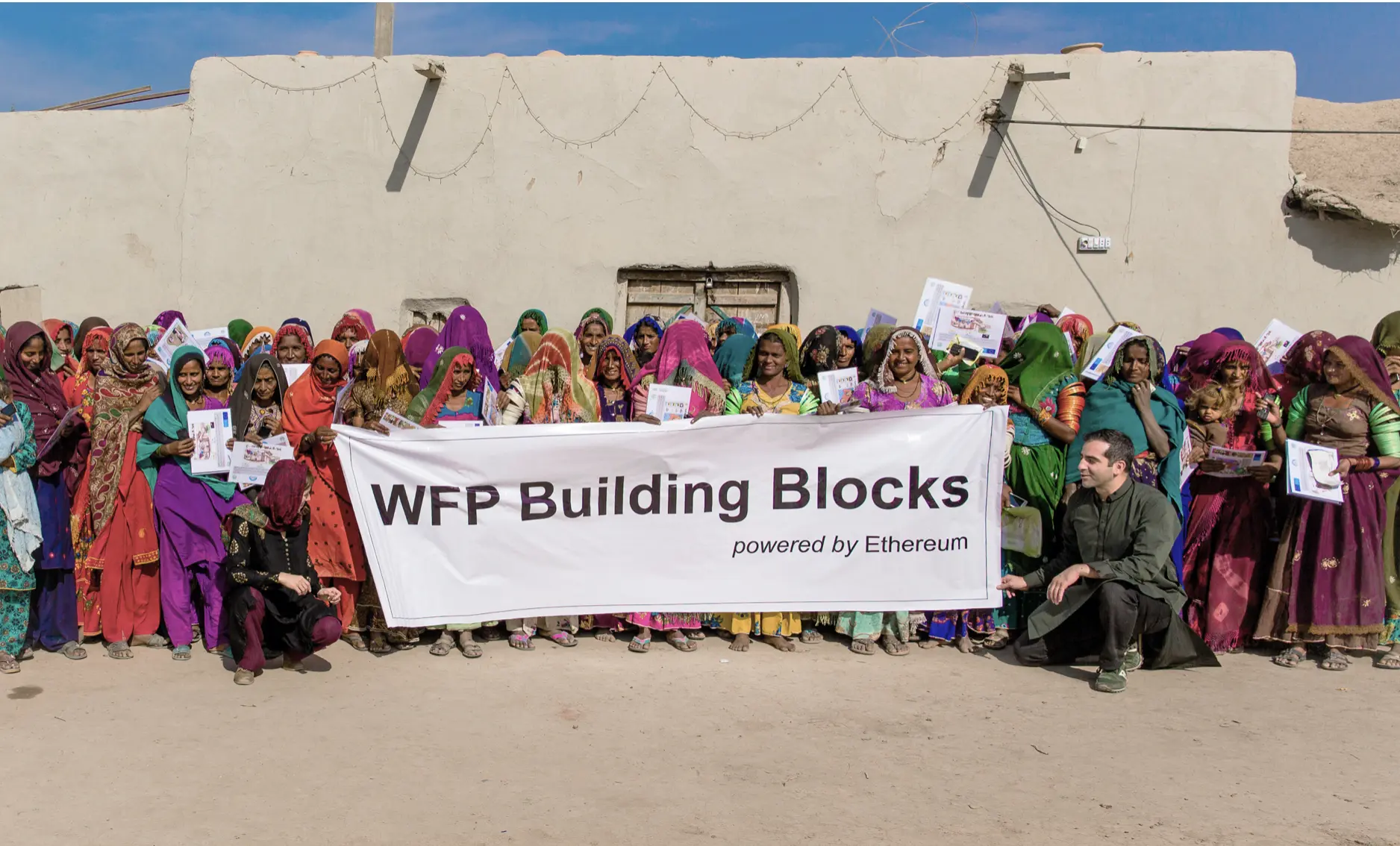
Building Blocks project has been launched in 2016 and claims the largest blockchain implementation for humanitarian assistance. Building Blocks aims to enable people to receive different types of assistance from multiple humanitarian organizations in one “go”, reducing the complexity of accessing humanitarian support without the requirement to store sensitive information, such as names, biometrics, date of birth, on the blockchain. The type of assistance provided by Building Blocks concerns, among others
- Food
- Nutrition
- Education
- Wealth
Building Blocks allows multiple organisations to
- Maintain up-to-date records of the services provided
- Track effort to ensure that effort is not duplicated
- Make sure that all targeted individuals are taken care
The organisation claims that 1 million people have been taken care of so far, with 325M million USD provided in a total of 15 million transactions. The project appears to be in its concluding stages although external organisations can apply for Innovation Challenges and receive equity-free funding, networking and support among WFP.
Cardano4Climate

Cardano4Climate, a group of climate activists working in the Cardano ecosystem on implimenting blockchain technology to climate actions. Cardano4Climate’s goal is to make solutions to Climate Change an inherent part of the activities of Cardano.
The community already inlcudes 300 members passionate about areas such as regenerative agriculture, green energy, carbon mitigation, plastic reduction, and forest conservation / planting. The community is active within Cardano’s Catalyst decentralized incubation program and help get initial funding for blockchain climate related initiatives.
Cardano4Climate invites anyone to join the movement and work together to find solutions to humanity’s greatest challenge, Climate Change.
This list is not by any means meant to be exhaustive and there are a number of institutions that centre their work around the SDGs that are working on DLT solutions via smaller working groups. Through involvement with any of the above organisations or CVA directly we hope that it can help your organisation to fast track alignment with the SDGs.
Author: Mehul Derodra, Head of Research at ImpactScope